Wednesday, November 16, 2022

Types Of Furnaces----Electric Arc Furnace(Four)

Electric Arc Furnace

Types Of Furnaces----Electric Arc Furnace(Four)


Electric arc furnace

These furnaces are used to produce special quality steels that are lighter products as reinforcing concretes. Electric Arc Furnace does not use any hot metals as basic oxygen routes. The equipment is charged with a cold material that will generally be steel scrap. Other raw materials include the products from iron ore. Direct reduced irons, iron carbide, and pig iron (the iron product from a blast furnace) that is cast and is allowed to get cooled are the included products. This process will not be charged directly.


The steel scrap is induced into the furnace by an overhead crane. Then a lid is used that is swung into position over a furnace. An electric current is passed through the electrodes that are positioned in the lowered that lower furnace. Other metals also get added to the steel that provides the required chemical composition. Oxygen is blown to purify the steel and lime in addition to the combined impurities. After sample collection, the furnace is tilted to pour the floating slag on the molten steel. The modern furnace can melt up to 150 tonnes in around 90 minutes.


Thursday, June 9, 2022

Types Of Steel

Types Of Steel

Types Of Steel


Strictly speaking, steel is just another type of iron alloy, and it's mainly including carbon steels, alloy steels, tool steels, and stainless steel four types.  

First, steel is still essentially (and overwhelmingly) made from iron. 

Second, there are literally thousands of different types of steel, many of them precisely designed by materials scientists to perform a particular job under very exacting conditions. 

When we talk about "steel", we usually mean "steels"; generally speaking, steels fall into four groups: carbon steels, alloy steels, tool steels, and stainless steels. These names can be confusing because all alloy steels contain carbon (as do all other steels), all carbon steels are also alloys, and both tool sheets of steel and stainless steels are alloys too. Now, we will explain the four different sheets of steel as following.

Carbon steels

The vast majority of steel produced each day (around 80–90 percent) is what we call carbon steel, though it contains only a tiny amount of carbon—sometimes much less than 1 percent. In other words, carbon steel is just basic, ordinary steel. Steels with about 1–2 percent carbon are called (not surprisingly) high-carbon steels and, like cast-iron, they tend to be hard and brittle; steels with less than 1 percent carbon are known as low-carbon steels and like wrought iron, are softer and easier to shape. A huge range of different everyday items is made carbon steels, from car bodies and warship hulls to steel cans and engine parts.

Alloy Steels

As well as iron and carbon, alloy steels contain one or more other elements, such as chromium, copper, manganese, nickel, silicon, or vanadium. In alloy steels, it's these extra elements that make the difference and provide some important additional feature or improved property compared to ordinary carbon steels. Alloy steels are generally stronger, harder, tougher, and more durable than carbon steels.

Tool steel

Tool steels are especially hard alloy steels used to make tools, dies, and machine parts. They're made from iron and carbon with added elements such as nickel, molybdenum, or tungsten to give extra hardness and resistance to wear. Tool steels are also toughened up by a process called tempering, in which steel is first heated to a high temperature, then cooled very quickly, then heated again to a lower temperature.

Stainless steels

The steel you probably see most often in stainless steel—used in household cutlery, scissors, and medical instruments. Stainless steels contain a high proportion of chromium and nickel, are very resistant to corrosion and other chemical reactions, and are easy to clean, polish, and sterilize.


Monday, June 6, 2022

Types Of Steel Rolling Mill Machine

Steel Rolling Mill Machine


Types Of Steel Rolling Mill Machine


There are many types of steel rolling mill machine that used to reduce the thickness of metal material or compress the material to create a uniform product such as the plate, wire rod, rebar, hot rolled coil, cold rolled coil and etc.

In addition, the steel rolling mills are divided into several types as follows:

Two-high rolling mills, which have a unique advantage in cost-saving cause the less expensive for manufacturing. And they are used for skin passing with small reductions of 1% to 2%.

Four -high rolling mills, which has a quick change roll system, can be equipped with roll bend and shape control and can be put in tandem, two to seven stands, instead of reversing mill.

Six-high rolling mills, which are similar to four-high rolling mills, also allows for substantial roll shape, depending upon the horizontal movement of the rolls. Furthermore, this kind of rolling mills is equipped with hydraulic screw downs, automatic shape control, and automatic gauge control.


Thursday, June 2, 2022

What Are Lubrication Methods Of Steel Rolling Mills?

Steel Rolling Mills


What Are Lubrication Methods Of Steel Rolling Mills?


The lubrication methods of Steel Rolling Mills are as followings: 


The basic methods of steel rolling mills lubrication are thin oil lubrication, dry oil lubrication, and oil mist lubrication. Thin-oil lubrication uses mineral oil (liquid lubricant) as a lubricant. Because the thin oil has the characteristics of fluidity, adhesion to the metal surface, certain viscosity and heat capacity, it can adhere to the surface of the lubricated part and can form fluid dynamic pressure, so that the friction surfaces are separated from each other. It also removes the heat generated by the friction from the friction surface. The performance of thin oil is relatively stable and has a certain antiseptic effect. However, the thin oil is not easy to seal, and the lubricating surface of the device easily invades impurities such as water and iron oxide.


Oil mist lubrication is a new way of lubrication. In the atomizer, the lubricating oil is atomized into extremely small oil particles under the action of filtered and compressed air. The fine oil particles are then mixed with the compressed air, and a small oil droplet is condensed onto the friction surface through the pipe and the condensation nozzle. Oil mist lubrication consumes less fuel, has a lower operating temperature, has a better lubrication effect, and saves maintenance costs. However, oil mist lubrication has high requirements for sealing of steel rolling mills, and strict requirements for oil quality and compressed air.        


Dry oil lubrication actually uses a grease-like grease (also called butter) as a lubricant. Grease is a grease made of lubricating oil plus thickener. Besides its lubricating property, it has strong adhesion, so it has good protection performance and seals the friction surface to avoid metal corrosion and impurity intrusion. After adding the grease once, the steel rolling mills can be operated for a period of time and is convenient to use. However, the energy consumption during operation is larger than that of thin oil, and it is not suitable for high-speed operation equipment.


Wednesday, June 1, 2022

What Are The Advantages Of The New Design Rolling Mill Equipment?

Rolling Mill Equipment

What Are The Advantages Of The New Design Rolling Mill Equipment?


What are the advantages of the new design rolling mill? What are the special rolls equipped?

As we know that in the process of improving the rolling mill equipment, its structure design has been obviously optimized and upgraded. So do you know what new advantages this rolling mill has after new design improvements? In fact, one of the most attractive aspects of the new equipment is the flexible adjustment of rolling speed.

In this way, in actual production, the working performance of rolling mill equipment will be brought into full play, which is also the basis of realizing automation and continuous operation. Of course, it also has many other advantages, such as when the latest design and production equipment in the production process can also ensure the tensile strength of finished steel bars, but also can greatly improve the elongation of broken steel bars and the maximum total elongation, and further improve the mechanical properties of products, to overcome the problem of low ductility of cold-rolled steel bars.

In addition, after improvement, the current rolling mill equipment adopts the passive one-rolling and one-towing production mode, which can realize two-pass rolling. It not only solves the problem of speed matching but also changes the traditional four-pass rolling mode and improves production efficiency significantly. At the same time, the automatic control calculation is flexibly applied to ensure that the product appearance size is accurate and the surface quality is excellent.

From the above introduction, we can see that continuous innovation and improvement will be able to further improve the performance of rolling mill equipment on the basis of the past. At the same time, it also significantly improves the quality of finished steel products, while improving production efficiency, bringing maximum benefits to customers. So, do you know what special rollers are equipped with them? In fact, rolls are very important components for any rolling mill equipment.

Even some rolling mills are equipped with special rolls to meet these special rolling requirements. For example, cemented carbide rolls, which are pressed and sintered with tungsten carbide powder, are suitable for high-speed rolling because of their excellent wear resistance. This roll is usually used in high-speed wire rod mills.


Sunday, May 29, 2022

What Are The Common Shearing Machine Of Rolling Mill?

rolling mill flying shear


What Are The Common Shearing Machine Of Rolling Mill?


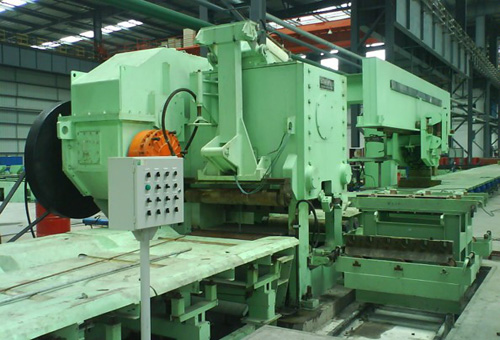
There are many kinds of shearing machines used in rolling mill workshop. According to the shape and configuration of shearing blades and the shape of rolling pieces, the shearing machine can be divided into parallel blade shearing machines, inclined blade shearing machines, disc shearing machines and various types of clippers.

The two blades of the parallel blade cutter are parallel to each other and are characterized in that both cutting edges are in contact with the metal being sheared at the same time. The shearing process is completed in a short time, the shearing efficiency is high, and the shearing machine is subjected to large load. It is commonly used for transverse hot shearing of rolled blanks (squares, slabs) and other square and rectangular section billets.

The two blades of the oblique blade cutter are angled, generally, the blade is inclined and the lower blade is horizontal. These shears are commonly used for cold shearing and hot shearing of steel sheets, steel strips, thin slabs, welded tube blanks, and sometimes for cutting small steel product.

The blades of the disc shear are made into discs. There are two types of disc shears used in the rolling mill workshop: one for longitudinal shearing of steel sheets and strips; and one for cutting heads of small steel product or wire production. Their common feature is the completion of the shearing task during the running of the steel by rotating pairs of disc cutting edges.

Flying shears are mainly used for sharing moving rolling stock transversely. Flying shears are used in section steel production, billet production, and steel sheet production. The cutting task is completed during the running of the steel, and thus the running speed of the steel is required to be substantially the same as the peripheral speed of the cutting edge. Most of these shears are placed on the line of semi-continuous or continuous mills.

Recently, in order to solve the problem that the shearing load is large, the walking beam shearing machine has appeared. The shearing process of this type of shear is performed in stages. In the above-mentioned various types of shearing machines, the eccentric shaft rotates one turn or less than one turn to complete one shearing action, while the walking beam shearing machine rotates the eccentric shaft into several turns to complete a shearing action. The eccentricity of the eccentric shaft on the step shear is small (usually 5~10mm). The walking beam shearing machine uses a set of stepping mechanisms to continuously change the position of the table to complete the entire cutting process.


Friday, May 27, 2022

What Are The Requirements For Rolling Mills For Lubrication?

Rolling Mills

What Are The Requirements For Rolling Mills For Lubrication?


Rolling mills requirements for lubrication:

Grease lubrication: such as the input ramp of the furnace in the hot strip mill, the pusher, the discharger, the stand, the stand, the mill ramp, the mill work, the motor bearing, the mill press, the universal joint shaft Grease with bracket, cutting machine, looper, guide, output ramp, tumbling machine, coiler, washing machine, turning machine, shearing machine, disc cutter, edger, boring machine, etc. lubricating;

Lubricating oil adopts circulating lubrication: For example, Baosteel 2030 five-stand cold rolling mill is an example, strip steel cooling and lubricating emulsion system and oil feeding system uncoiler, five machines, feeding hoe, electric motor, rolling shear, guide, Lubrication of steering rollers and coilers, gear oils, leveling machines, etc., oil film bearing systems for each frame. Bearings for high-speed, high-precision rolling mills, lubricated with oil mist and oil and gas. 

Let’s talk about it in detail below:

Hot-rolled sheet steel strip mill requirements for grease:

Strip technology is the technology with the highest technical content and the highest added value of products in rolling steel production. In order to improve the shape and surface quality of the rolled products, most of the strip mills use CVC, bending rolls, nip rolls, and other world-class technologies. However, due to the harsh bearing conditions of such rolling mills, the selection of suitable greases is carried out. Lubrication is especially important.


Plate type rolling steel work roll housing high temperature: the billet temperature is above 1200 °C. During the rolling process, the radiant heat and conduction heat can make the work roll housing temperature reach 100 °C or above.

Heavy load: the rolling mill bearing is subject to a large rolling force and impact load, especially due to the joint action of the CVC rolling mill, the nip roller and the bending roller, the rolling force of the rolling mill bearing can be decomposed into the axial force and the radial force. The axial force is mainly caused by the roll (the roll is plus or minus 100 mm), and the radial force is mainly composed of the rolling force and the bending force (the bending force is 120 tons/roll neck).

Multi-water: During the rolling process, a large amount of spray water is required to cool the rolls, and the spray water can easily enter the bearing, especially the lower work rolls.

High speed: The billet has a high rolling speed in the finishing zone, and the wire speed of the F6 frame can be 13m/s. Rolling mill bearings require excellent high-temperature resistance: the thickener of the rolling mill bearing grease has high physical stability, does not melt or decompose at the ambient temperature used; the tendency of the grease to soften at high temperatures is small; Has good thermal reversibility. The lipid drop point should be greater than 250 ° C to ensure that it can be used in high-temperature environments. It also has good pumping performance at lower temperatures and a wider temperature range.

Excellent water resistance: the consistency of the rolling mill bearing grease should not be much lower after it is in contact with water or even mixed with water. It prevents the loss of lubricant and reduces the lubricity, and it still has good protection.

Excellent rust and corrosion resistance: The bearing grease of the rolling mill should be able to maintain good protection and lubricity in the water vapor and dust environment and prolong the life of the bearing.

Good extreme pressure and wear resistance: the rolling mill bearing grease should be able to withstand a large rolling force and impact load, especially under the joint force of CVC rolling mill, nip roller and bending roller, it can form a good oil film thickness.


Wednesday, May 25, 2022

What Is Cold Rolling Mill ?

Cold Rolling Mill

What Is Cold Rolling Mill ?

What is cold rolling? I believe people who will be very interesting in "What is Cold Rolling"?  

If the temperature is below its recrystallization temperature when mental rolled, the process is called cold rolling. 

Cold rolling is fulfilled by making steel strip through plenty of tandem rolling mill stands. And each one of stands has vertically stacked rolls that are powered by a huge motor to impart high compressing stresses into the strip. 

Cold-rolling mills can produce various products like the smooth tin plates flowing like water, shiny galvanized plates glittering like mirror and other colorful coated sheets. They can then be pressed into cans or applied on industrial machines and household appliances or even just for decoration. 

What rolling mills do are not just limited to those plates. Rods, bars, wires, rails... You name it. All these productions can be easily achieved just like the plates with rollers in different shapes. 

With the emergence of new technologies in this field, it’s not hard for us to believe that the rolling mills in the future will be smarter and much more powerful. The application of those new technologies will lead us to cost reduction, quality insurance and the improvement of competitive abilities. 


Tuesday, May 24, 2022

What Are The Advantages Of Non-Twist Rolling Mill?

Non-Twist Rolling Mill

What Are The Advantages Of Non-Twist Rolling Mill?


What are the advantages of the non-twist rolling mill in the application?

Rolling mill is mainly for various products, but if you want to achieve good production results, then the type of mill you choose must be fully matched with all aspects, so the ability of ordinary rolling mill must be relatively limited, but after the improvement of the new equipment is different, such as the non-twist rolling mill ! No matter in the quality of the tied piece or the rolling efficiency, there are obvious improvements.


Understand what is the non-twist rolling mill?

What is a non-twist rolling mill, in fact, in the rolling mill set, the use of all-flat layout, effectively achieve the whole line of the non-twist rolling process, to put it simply, this rolling mill in the whole process of rolling, without any twist.

It is precisely because of these minor improvements that the utilization ratio of the rolling mill has been greatly improved, and the overall productivity of rolling mill has been increased. At the same time, the different defects that may occur during the twisting of the tie piece have been improved. The most important thing is to improve the rolling quality.


Monday, May 23, 2022

What is Hot Rolling?

hot rolling


What is Hot Rolling?


Rolling mill is a metalworking process which divided into two types: hot rolling and cold rolling. Here we will analyze the hot rolling cause we had discussed cold rolling before.

In many theory books, which called hot rolling is a metalworking process that occurs above the recrystallization temperature of the material. On the contrary, it means that below the recrystallization temperature of the metalworking process is called cold rolling.

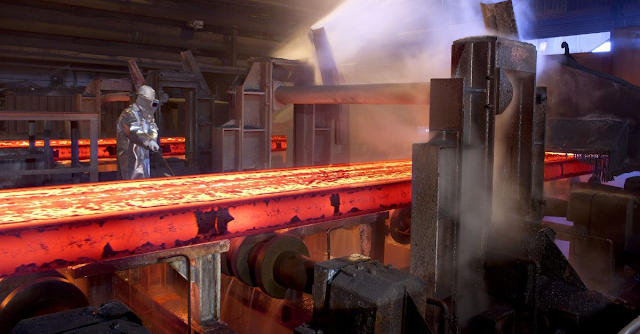
But what is hot rolling besides of this word. Here we have the detail explanation about it. After the grains deform during processing, they recrystallize, which maintains an equiaxed microstructure and prevents the metal from work hardening. The starting material is usually large pieces of metal, like semi-finished casting products, such as slabs, blooms, and billets. If these products came from a continuous casting operation the products are usually fed directly into the rolling mills at the proper temperature. In smaller operations, the material starts at room temperature and must be heated. This is done in a gas- or oil-fired soaking pit for larger workpieces and for smaller workpieces induction heating is used. As the material is worked the temperature must be monitored to make sure it remains above the recrystallization temperature. To maintain a safety factor, finishing temperature is defined above the recrystallization temperature; this is usually 50 to 100 °C (90 to 180 °F) above the recrystallization temperature. If the temperature does drop below this temperature the material must be re-heated before more hot rolling. All of this above, just part of the hot rolling actually.

Hot rolled metals generally have little directionality in their mechanical properties and deformation induced residual stresses. However, in certain instances, non-metallic inclusions will impart some directionality and workpieces less than 20 mm (0.79 in) thick often have some directional properties. Also, non-uniformed cooling will induce a lot of residual stresses, which usually occurs in shapes that have a non-uniform cross-section, such as I-beams. While the finished product is of good quality, the surface is covered in mill scale, which is the forms at high temperatures. It is usually removed via pickling or the smooth clean surface; process, which reveals a smooth surface.  Dimensional tolerances are usually 2 to 5% of the overall dimension.

Hot rolled mill steel seems to have a wider tolerance for amount of included carbon than cold rolled, making it a bit more problematic to use as a blacksmith. Also for similar metals, hot rolled seems to typically be less costly.

Hot rolling is used mainly to produce sheet metal, rebar, wire rod or other products. In a words, hot rolling is very popular used in the steel industry.


Since 1989 Hani Tech has been always involved in design, engineering, manufacturing and installation of complete hot rolling mill plant for long products (re-bars, SBQ bars, wire rod, small and medium sections), as well as revamping and upgrading of existing plants. 

Hani Tech is the one-stop manufacturer & supplier able to design, manufacture, install and commission your hot rolling mill plant from A to Z.


Sunday, May 22, 2022

Bar & Wire Rod Rolling Mill Production Line Process Flow (Complete Version)


Bar & Wire Rod Rolling Mill Process Flow

Bar & Wire Rod Rolling Mill Production Line Process Flow (Complete Version)


1. Bar Rolling Mill Production Line Process Flow 

Billet acceptance → reheating → rolling →double length shear → cooling → shear → inspection → packaging → metering → warehousing

2. Process Flow of Wire Pod Production

Billet acceptance → reheating →rolling → laying head → bulk coil cooling → coil collection → coil pressing → inspection → packaging → metering → warehousing

The process of acceptance, reheating and rolling of billet in wire rod production is basically the same as that of bar mill production, but the cooling of wire rod is carried out by the scattered cooling roller. The cooled bulk wires need to be collected into discs by the coiler and then compacted by the coiler and packed in small discs. Then the inspection classification is packed into large bales and measured in storage.


3. Analysis and Treatment of Bar and Wire Rod Production Process Fault


Can not rolling

1. Causes: 

1.Rolled piece rotten head, split head, black head, etc. 

2. Improper or too small installation of inlet guide; 

3.There are sticky iron or foreign bodies in the inlet guide; 

4. The roll over angle is too large or too small; 

5.Rolling guide wheel does not rotate or bearing burns out; 

6.Roll does not turn due to breakage or connection; 

7.Improper adjustment of roll gap or unsatisfactory size of incoming material; 

8. Roll pass friction coefficient is too small (new pass), etc.


2. Analysis and Treatment and Preventive Measures

(1) Analyse the reason why the rolled piece is not in progress, strengthen the inspection of the head defect of the rolled piece and dispose of it in time;

(2) After installation of the inlet guide, measure the width and dimension of the inlet cavity with the internal caliper; Illuminate with light and check whether the inlet guide is centered on the hole pattern from the outlet direction and tighten the guide bolts;

(3) Check and measure the solid size of the rolled piece with calipers to ensure the correct size of incoming material;

(4) Roll gap size is strictly adjusted according to rolling requirements;

(5) Check rolling guide wheel and twist outlet frequently and replace in time; Check import guide regularly for sticking of iron night and depositing of iron oxide scale or debris;

(6) New hole pattern shall be tested with small material first.


Rolling Heap Failure


Steel heap failure refers to stagnation after accumulation of rolled pieces between rolling mills or rolling mills, which is called steel heap failure.

1. Causes

A. The size and section area of incoming roll are too large; The rolled piece itself has surface or internal quality defects.

B. The friction coefficient of roll pass is not enough, causing slippage of the rolled piece;

C. Volume flow per second of incoming mill is greater than that of receiving mill.

D. Electrical control system is wrong or out of control.

E. Installation of mechanical running part or photoelectric control instrument of automatic looper system is wrong, out of control or out of function.


2. Analysis and Treatment and Preventive Measures

A. Adjust the size and area of incoming material to satisfy the reasonable continuous rolling constant relation;

B. Monitor the running condition of the rolled piece dynamically and tightly and adjust it in time;

C. Ensure the quality of the ingot; Disposal of semi-finished rolled parts with quality defects in time;

D. Check the rotational speed, looper system and electrical control system of each rolling mill regularly to ensure the stable and normal running equipment and electrical control system.


Steel Pulling Failure of Rolled Parts


Steel pulling failure refers to the phenomenon that the rolled pieces are too tight or broken between rolling mills or rolling mills, which is called steel pulling failure. Due to the failure of steel drawing, the dimension of the rolled piece often changes, and even the shape dimension or roundness of the finished product is out of tolerance, causing scrap.


1. Causes

A. The size and section area of incoming roll are too small;

B. Volume flow per second of incoming mill is less than that of receiving mill.

C. Electrical control system is wrong or out of control.


2. Analysis and Treatment and Preventive Measures

A. Adjust the size and area of incoming material to satisfy the reasonable continuous rolling constant relation.

B. Ensure that the electrical and electronic control equipment systems work properly.


Wednesday, May 18, 2022

What Is Steel Rolling Mill Machinery?

Steel Rolling Mill Machinery


What Is Steel Rolling Mill Machinery?


The steel rolling mill machinery is a mechanical device that realizes the metal rolling process. It refers to the equipment that completes the whole process of rolling material production, including main equipment, auxiliary equipment, lifting transportation equipment and auxiliary equipment.

Steel rolling mill machinery can be divided into two parts: main rolling mill equipment and rolling mill auxiliary equipment.


Steel Rolling Mill Machinery Main Equipment

The main equipment of the steel rolling mill machinery includes the main motor, the working machine base and the main transmission (reducer, gear base, coupling, coupling shaft, etc.).

The steel rolling mill machine working machine seat is composed of a roll, a roll bearing, a frame, a rail seat, a roll adjusting device, an upper roll balancing device and a roll changing device.


Steel Rolling Mill Machinery Auxiliary Equipment

Auxiliary equipment for steel rolling mill machinery includes:

Transport equipment, such as the roller conveyor for longitudinal transport of rolled products, the lifting platform for transporting rolling stock in the vertical direction, and the steel pulling machine and steel moving machine for transversely transporting rolled stock.

Processing equipment, such as shearing machines (flying shear, gripping shear) and hot saw machines for cutting rolled products, straightening machines for straightening rolled products, and coilers for taking up rolled products.

Other finishing equipment, such as a steel turning machine for reversing rolling stock, a rotary table for revolving rolling stock, and a cooling bed for cooling rolled products.

And various mechanical equipment used in the processes of collection, pickling, printing, packaging, etc.

In general, the higher the degree of mechanization, the greater the proportion of auxiliary equipment weight to the total weight of the rolling mill workshop machinery.

Therefore, the degree of application of auxiliary equipment is also one of the important signs of the degree of mechanization of the rolling process.


Monday, May 16, 2022

High-Speed Wire Rod Mill Production Line Process Flow

high-speed wire rod mill


High-speed Wire Rod Mill Production Line Process Flow


Billet preparation: 150 mm *150 mm *14 000 mm continuous casting billet.

Reheating furnace: The billet is heated to austenite temperature to facilitate rolling. 

High-pressure water descaling: After the billet is heated in the reheating furnace, before entering the roughing rolling mill, it is necessary to descaling with high-pressure water to remove the oxide scale and secondary oxide scale on the billet surface, so as to avoid defects on the pressed surface. 

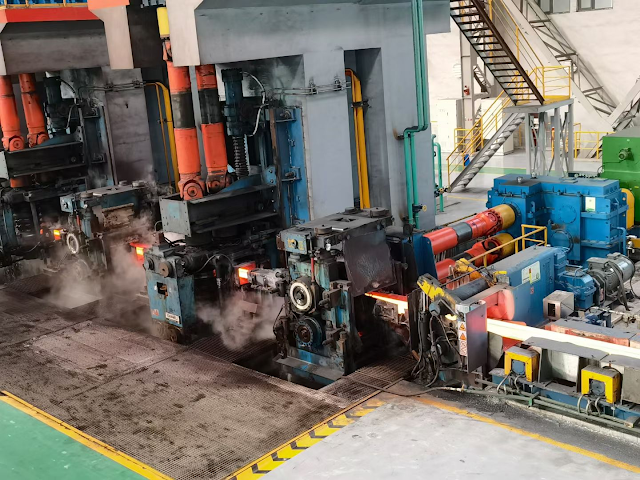
Roughing mill, medium rolling mill, and finishing rolling mill rolling: the size of finished products, including 6 roughing rolling mills, 6 medium rolling mills, 4 pre-finishing mills, 10 finishing mills, a total of 26 rolling mills on this high-speed wire rod mill production line.

Flying shear head and tail: Before entering each set of rolling mills, the work of cutting head and tail must be carried out in order to remove the head with too low temperature to avoid damage to the roll surface and prevent the head of the rolling piece from being stuck in the inter-stand guide device. The stuck shear is used to crush and break the rolling event before the medium rolling mill, the pre-finishing mill and the finishing mill in the accident state.

Water cooling: In order to reduce the rolling temperature entering the finishing mill, a water tank is set before the finishing mill to control the finishing temperature. 

Rolling: Rolled wires are rolled into rolls after cooling through water, forming loose rolls through spinning.

Stelmore uncoiled cooling: The cooling speed of the controlled cooling line is controlled according to different steel grades and product uses, so as to obtain the corresponding product quality. 

Finishing and transportation: including coiling, dressing, inspection, sampling, baling and rolling, weighing and hanging tags, using the coiling device to collect loose rolls, and hanging them on the C-hook on the P-S transport line, completing the process of coiling, dressing, inspection, sampling, baling and rolling, weighing and hanging tags in turn, and then unloading and entering the warehouse.


Thursday, May 12, 2022

What is Walking Beam Cooling Bed?

Walking Beam Cooling Bed


What is Walking Beam Cooling Bed?


Walking Beam Cooling Bed Introduction: 


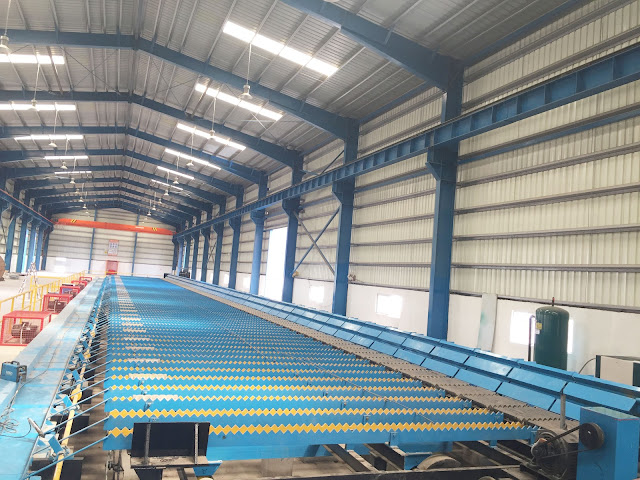
(1) The Usage of Walking Beam Cooling Bed: Arranged behind the rolling mill for cooling of finished steel and bar products. Cooling finished product specifications Φ10 ~ 40mm rebar, Φ10 ~ 50mm round steel. The steel grade is plain carbon steel, excellent carbon steel, and low alloy steel. The speed of the large finished product is 16m/s and the annual production capacity is 600,000 tons.

(2) The rolling mill cooling bed type is the walking beam type of the rack. The effective size of the bed is 96000×9500mm. The large length of the steel is 90m, the pitch of the tooth is 100mm, the thickness of the rack is 18mm, the spacing of the static rack is 300/600mm, and the distance between the racks is 300/. 600mm.

(3) Walking beam cooling bed input roller: roller diameter Φ188mm, roller length 190mm, roller distance 1200mm, inclination angle 12°, drive type single machine drive, variable frequency speed regulation, irreversible, roller line speed 4.5~20m/s(max), motor YVPG100L2-4 , 2.2KW, 1500rpm, each motor with axial flow fan 125FZY2-S, 25W, 220V, 50HZ, the number of 115; 6 free rolls.

(4) Walking beam cooling bed dial-in mechanism: the width of the dial-in block is 150mm, the length of the dial-in block is 138m, the angle between the dial-in block and the horizontal is 35°, the angle between the dial-in block and the vertical is 12°, and the speed of the dial-in block is 0.15~0.3m/s. The dial-in block is lifted and hydraulic cylinder Φ63/Φ45x90. Pneumatic gear cylinder QGAIIΦ80×20-MP4, 1; compressed air working pressure 0.4~0.6Mpa, cycle 4s~12s.

(5) Walking beam cooling bed surface drive: main motor Z4-280-21, 132kW, speed 750/1600rpm, 2 sets; photoelectric encoder LAKESHORE, 2; reducer A=508mm, I=41, 4 sets; eccentric wheel eccentricity 50mm. The rack moves once the steel stroke by 100mm.

(6) Alignment roller path: roller diameter Φ225/165mm, roller length 810mm, effective number of teeth 6, roller surface speed V=1.1m/s, roller spacing 1200mm; reducer BWD1.5-18-11, I=11 , motor Y90L-4, 1.5KW, 1400rpm, the number is 45; the number of free rollers is 18.

(7) Chain type steel transfer machine: Transfer steel specifications ф12 ~ ф50mm. The length of the steel is 90m, the width of the chain transfer machine is 1500mm, the chain spacing is 1200mm, the chain speed is 0.2m/s, the stepping distance is 20~70mm, the transmission motor is YTSP160M-4, 11KW, 1500rpm, AC380V, 2 sets. The center distance of the reducer is 349mm, the transmission ratio is I=1:75, and the number is 2.

(8) Transport trolley: the width of the trolley is 1000mm, the lifting time of the trolley is 1~2s, the round-trip speed of the trolley is ~0.5m/s, the transmission motor: YTSP132S-4, 5.5KW, 1500rpm, AC380V, 2 sets, reducer: A=349mm, I = 1:45, 2 sets. The trolley is lifted and used with a hydraulic cylinder.

(9) Output roller path: roll diameter: Φ188 mm, roll length: 1000 mm, roll distance: 1200 mm, roll line speed: 2 m/s, number of rolls 86, 6 free rolls. Roller motor: YGb112L2-4, 1.5KW, 1450rpm, AC380V, 80 units, reversible.


Wednesday, May 11, 2022

What Should The Rolling Mill Need To Pay Attention To During The Shutdown?

Rolling Mill

What Should The Rolling Mill Need To Pay Attention To During The Shutdown?


In the production process of the rolling mill, what should be noticed after the rolling mill is shut down when there is a downtime overhaul or an unexpected situation?

1. After the rolling mill stops, stop the feeding of steel, and take the gas cutting and cutting out of the online rolling parts to avoid the stress on the rolls and cause damage.

2. If the rolling mill needs long-term shutdown, the best method is to open the lubrication system to keep the main bearing lubricated, and then close it in to avoid dust and debris entering the bearing.

3. Cut off the power supply of the rolling mill and auxiliary equipment.

4. Drain the water in the cooling tube to avoid freezing the cooling water pipe when it is cold.

5. Protect the lubrication system, motor, air clutch and slow drive from dust, but not tightly sealed to avoid moisture accumulation. Use a small heater or protect the bulb to prevent moisture buildup.

6. Place bagged desiccant in all control and electrical panels to prevent moisture build-up and safely seal the control panel.

The above need to pay attention to is that the rolling mill production enterprises need to pay special attention to it. Only when the rolling mill is under maintenance, the rolling equipment can better complete the production task during the production period, improve the rolling efficiency and extend the usage time of rolling mill.


Tuesday, May 10, 2022

What's The Difference Between Hot Rolling And Cold Rolling?

cold rolling and hot rolling

What's The Difference Between Hot Rolling And Cold Rolling?


Hot rolling has the following characteristic, low intensity, good extension, the surface is not shinning.

Cold rolling has the following characteristic, high intensity, high hardness, shining surface.

Hot rolling mill: though high heating, then rolling it to the certain structure.

Cold rolling mill: not heating, in common temperature, normally below critical point.

The mechanical property through hot rolling and cold rolling is different.

Cold rolling is in low hardness, easy to process, with good intention, easy to form cold stress, hot rolling is for high hardness, high intention, difficult to process, not easy to deformation. 

Hot rolling needs to be heated, normally temperature should above the critical point, the processing is under high temperature, make the steel recrystallization happen, but not changing the steel structure.

Cold rolling is under normal temperature, roll it into aiming thickness, compare with hot rolling , cold rolling has high accuracy, smooth surface, better mechanic characteristic, especially processability, because the raw material of cold rolling is very crisp and hard, not suitable for processing, normally, cold rolling steel plate should be acid pickling and surfacing, then can send them to final customer.

The difference between cold rolling and hot rolling is not in the process, but the temperature, hot rolling is easy to roll, and high efficiency, but hot rolling makes steel oxidation, surface gray and not shining; cold rolling requires high power motor, low efficiency, high cost, but with very shining surface, can be used as the final product directly, widely used.


Monday, May 9, 2022

Why High-Speed Wire Rod Mill Adopts Collective Transmission Mode?

wire rod mill

Why High-Speed Wire Rod Mill Adopts Collective Transmission Mode?


In high-speed wire rod mill, the finishing mill adopts collective transmission mode, which is due to:

1) In order to shorten the excess length of the head and tail of the rolling piece caused by drawing, the structure of the rolling mill is required to be as compact as possible, so that the space between the stands is very small. Under this compact condition, it is impossible to arrange the rolling mill as a single transmission. 

2) The finishing mill of high-speed wire rod mill not only has high speed but also needs to be adjusted to different speeds according to different product specifications. If it is driven separately, the number of frames is large, and the speed required by different product specifications varies greatly in different sorties. Therefore, the required electrical control system will be very complex, and at the same time, it must have high sensitivity to adapt. 

Therefore, even if the electrical system can do it, it is difficult to maintain the micro-tension rolling relationship between the racks for all product specifications. 

3) The combined structure of collective transmission greatly improves the dynamic speed drop of the motor at the moment of biting and makes the micro-tension relationship between the stands unaffected by the electrical equipment, thus creating favorable conditions for the micro-tension rolling at high speed. 

In summary, the design of roughing mill, medium rolling mill and pre-finishing mills using AC motor drive alone, finishing mills using AC motor collective drive.


Thursday, April 14, 2022

Wire and Bar Rolling Mill & Reducing and Sizing Mill


Wire and Bar Rolling Mill

Wire and Bar Rolling Mill & Reducing and Sizing Mill


For a long time, the output of bar and wire rod in China has been between 40% and 50% of the total output of iron and steel products. In recent years, the total output of bar and wire rod has exceeded 400 million tons. Except for about 10% of exports, the rest of the output is used for domestic digestion. It can be seen that bar and wire rod products play a very important role in national economic construction. There are more than 1000 production lines in China. 

Since the 1980s and 1990s, China has introduced foreign advanced bar and wire rolling mill one after another. By digesting, transforming and upgrading this technical line, China's domestic bar and wire rolling mill equipment have approached the world's advanced level. With 12% of the imported international advanced level production lines, at present, it is above the domestic advanced level. Some of them accounted for about 75% and became the mainstream of the market. Another 20% of the ordinary rolling mills adopt the twist rolling process with large output, which is only suitable for the production of ordinary carbon steel. There are still 5% backward mills to be eliminated.

After more than 30 years of development, the types of bar mills can be classified into three categories: closed two-high mill, short stress path mill and cantilever roll ring mill. Among them, the closed two-high mill is mainly Morgan type and Simac type (including Demark type). Through introduction and digestion, Morgan type closed mill has been successfully applied to hundreds of domestic production lines. The main imported models of short stress path rolling mill are Danieli type and Premini type. Our major research institutes have developed their own brand of short stress path rolling mill, which has been applied in hundreds of bar and wire production lines in China. Cantilever roll ring mill is only developed by Danieli, but it is seldom imported in China, such as Laigang and Tangshan Iron and Steel Company, which is only used in roughing mill.

Bar reducing and sizing mill is a kind of mill installed in bar finishing mill to improve product size accuracy and product performance (rolling by controlling temperature). It is mainly used for a bar of special steel. Reduced sizing mill is different from common mill in three aspects: first, using clutch with speed ratio to meet the needs of different rolling speeds of all products; second, using minimum mill center distance to reduce the size impact of micro-tension rolling; third, using single pass carbide roll ring, roll as double support. Support to ensure sufficient stiffness to meet a wide range of product specifications. At present, there are two types of imported machines in China: two-high mill and three-high Y mill. The two-roll mill is mainly of the predominant type and the Danieli type. There are three-stand flat-vertical arrangement and a four-stand flat-vertical arrangement. The roll system of the mill adopts the frame structure of the short stress line mill with high stiffness. Three-roll Y mill is mainly KOCKS type and Simac type. It usually consists of 3-5 stands. Roll passes are arranged alternately by Y-Δ. 


wire rolling mill


steel rerolling mill

Wednesday, April 13, 2022

Hot Strip Rolling Mill Plant | Hot Strip Mill in Steel Plant | Strip Rol...


There are four types of hot strip rolling mill according to product width and production process: hot strip rolling with a wide strip, reversible hot strip rolling with a wide strip, hot strip rolling with a narrow strip, and hot strip rolling with a planetary rolling mill. The materials used for strip steel are plain carbon steel, low alloy steel, stainless steel, and silicon steel. It is mainly used for raw materials of cold-rolled strips, welded pipes, cold-bent, and welded sections, or for making various components.


Tuesday, March 29, 2022

What is a Wire Rod Mill Laying Head?

Wire Rod Mill Laying Head


What is a Wire Rod Mill Laying Head?


The laying head of wire rod mill is the key equipment in high-speed wire production to spin rolled wires into coils for collection.

Wire rod mill laying head is one of the key equipment in high-speed wire production and an important bottleneck restricting further speed-up of high-speed rolling mill. The quality of wire spinning directly affects the physical quality of high-speed wire. With its special shape structure and certain speed, the laying head changes the straight current wire moving at high speed into coils with stable ring shape and uniform spacing. With the increase of wire rolling speed and output, the requirement for wire rod mill laying head is getting higher and higher. Therefore, many high-speed wire production enterprises will have unstable coils in production, which will affect product quality and smooth production.

With the development of wire production technology, horizontal wire rod mill laying head has become the throat part of the production line as a coiling equipment matching with the uncoiled cooling line. Its function is to guide the wire rolled from the finishing mill K1 or pinched in a straight line into a horizontal laying head machine. The wire slips relatively without twist in the tapping tube with rotation. Under the action of centrifugal force, Coriolis force, inertia force and friction force, it bends and deforms gradually along with the shape of the tapping tube, reaches the required curvature at the outlet, forms the spiral coil and realizes its working purpose.

The high-speed wire rod mill laying head is a horizontal structure, which is located between the water-cooled box and the cold-controlled roll track of the controlled cooling line after the finishing mill. Horizontal laying head machine is composed of transmission device, shield, tapping disc, hollow shaft, tapping tube, bearing seat, motor, bevel gear pulley and other components. The threading machine is driven by a motor and driven by a pair of bevel gears meshing in the gear box to rotate the hollow shaft. The threading tube is installed on the threading disc, which is connected with the hollow shaft by bolts. 


wire rod mill laying head


Wire Rod Mill


Friday, March 18, 2022

Walking Beam Cooling Bed

Walking Beam Cooling Bed

Walking Beam Cooling Bed

The walking beam cooling bed and continuous casting billet turnover cold bed series products are mainly applicable to bar, profile and billet production lines in iron and steel smelting industry. The step-by-step cold bed can meet the annual production capacity of 100-1 million tons.

The walking beam cooling bed consists of four parts, i.e. feeding system, body of the cold bed, leveling device and feeding device. The feeding system uses cylindrical roller bed to be tilted and positioned. Frequency converter roller bed motor drives independently. The feeding on roller bed is braked by a single skirt. The feeding mechanism includes curved plate type, pinch roll belt trough type and brake apron type. Brake apron lifting includes hydraulic, mechanical and other structural forms. The cold bed is step-by-step. Input roller is controlled by frequency conversion or driven directly by AC, while output roller is driven by AC.

Walking beam cooling bed is the working table for effective cooling of rolled products (threaded steel, round steel, steel pipe, etc.) in metallurgical rolling steel industry.

Classification:

 The walking beam cooling bed mainly include pull-tooth type, rack step type, pawl type, chain type and roller type.

Composition: 

The walking beam cooling bed consists of mechanical transmission system, water cooling system, working table of the cold bed, fixing support, etc.

Working principle: 

The rolled products are conveyed into the cold bed through the roller track, and then the work pieces arranged on the cold bed are moved to the top of the cold bed step by step by step by rack pulling the teeth. The cooling effect of the work pieces is achieved.

Main application: 

The walking beam cooling bed equipment is mainly used for slow natural cooling of rolled steel plate on-line. On the profile production line, the cold bed also has the function of pre-bending the profile to prevent irregular bending of the profile due to unequal quality everywhere during the natural cooling process.

Application field: 

Walking beam cooling bed is mainly used in iron and steel industry, metallurgical industry, etc.

Environment and Conditions for Equipment Use: 

Ambient Temperature: -20-+40 C

Working environment: not suitable for flammable and explosive

Altitude: +108 M


walking beam cooling bed


Tuesday, March 15, 2022

What is a Rolling Mill?

rolling mill

What is a Rolling Mill?

The steel rolling mill is the equipment to realize the metal rolling process. Generally refers to the equipment used to complete the whole process of rolling production, including main equipment, auxiliary equipment, lifting and transportation equipment and ancillary equipment. But generally speaking, the rolling mill only refers to the main equipment.

II. Nomenclature of Rolling Mill

It is named after the type of rolled product, the type of mill and the nominal size. The principle of "nominal dimension" refers to the section mill as the pitch diameter of the herringbone gear of the gear base; the blooming mill as the nominal diameter of the roll; the strip mill as the length of the working roll body; and the steel tube mill as the maximum diameter for production. It is sometimes named after the inventor of a rolling mill (e.g. Sendzimir mill).

III. Selection of Rolling Mills

The type and dimension of finished or semi-finished rolling mill shall be selected according to the requirements of product variety, specification, quality and output, equipped with necessary auxiliary, lifting, transportation and accessory equipment, and finally balanced according to the requirements of various factors.

IV. COMPONENTS OF STEEL ROLLING MILLS

1. Work stand: composed of roll, roll bearing, frame, rail seat, roll adjustment device, upper roll balance device and roll changing device, etc.

2. Roll: It is a part that makes metal plastic deform.

3. Roll bearing: support the roll and maintain the fixed position of the roll in the frame. Roll bearings vary greatly with heavy working loads, so small coefficient of friction, sufficient strength and stiffness are required, and rolls can be easily replaced. Different types of roll bearings are used for different mills. Rolling bearings are mainly used for work rolls of strip mills because of their high rigidity and small coefficient of friction, but their small pressure-bearing capacity and large size. Sliding bearings have two types: semi-dry friction and liquid friction. Semi-dry friction roller bearings are mainly bakelite, copper and nylon bearings, which are relatively inexpensive and are mostly used in profile mills and billet openers. There are three kinds of hydrodynamic, hydrostatic and hydrostatic bearings. The advantages are small friction coefficient, large pressure-bearing capacity, high working speed and good rigidity, while the disadvantage is that the oil film thickness changes with speed. Liquid friction bearings are mostly used for support rolls in strip mills and other high-speed mills.

4. Mill stand: It is composed of two "archways" to install the roll bearing block and roll adjusting device. It needs sufficient strength and steel strength to withstand the rolling force. There are two main types of rack, closed type and open type. Closed stand is an integral frame with high strength and rigidity, mainly used for blooming mills and strip mills with high rolling force. Open frame is composed of frame body and upper cover, which is easy to change rolls. It is mainly used in cross section mills. In addition, there are no archway mills.

5. The rolling mill track base is used to install the frame and fix it on the foundation, also called the floor plate. To withstand the gravity and tipping moment of the worker base while ensuring the accuracy of the mounting dimensions of the worker base.

6. Roll adjustment device: used to adjust the roll gap so that the rolled piece can reach the required section size. Upper roll adjustment device, also known as "press-down device", has three kinds: manual, electric and hydraulic. Manual press-down devices are commonly used in profile mills and small mills. Electric press-down device includes electric motor, reducer, brake, press-down screw, press-down nut, press-down position indicator, spherical pad and pressure gauge and other components; it has low transmission efficiency, large rotating inertia of moving parts, slow reaction speed and low adjustment accuracy. Since 1970s, AGC (Automatic Thickness Control) system has been used in strip rolling mills. Hydraulic press device has been used in new strip cold, hot and thick rolling mills, which has the advantages of small thickness deviation and high product qualification.

7. Upper roll balancing device: device used for lifting upper roll and preventing impact of rolled parts when entering and leaving the roll. Forms are: spring type, multi-purpose on profile rolling mill; hammer type, commonly used on blooming mill with large roll movement; hydraulic type, multi-purpose on four-roll strip rolling mill.

In order to improve the operation rate, it is required that the roll change of the rolling mill be quick and convenient. Roll change modes are C-hook type, sleeve type, trolley type and frame type. Roll change in the first two ways is assisted by crane, while the whole frame requires two sets of frame for roll change. This method is mostly used for small mills. Car roll change is suitable for large rolling mills and facilitates automation. At present, the rapid automatic roll changing device is used on the rolling mill. It only takes 5-8 minutes to change the roll once.

8. Driving device: It consists of electric motor, reducer, gear seat and connecting shaft. The gear base distributes the drive torque to two or more rolls.

9. Auxiliary equipment includes a series of equipment for auxiliary process in rolling process. Such as raw material preparation, heating, steel turning, shearing, straightening, cooling, flaw detection, heat treatment, pickling and other equipment.


rolling mill for sale


Sunday, March 13, 2022

12000KN Cold Shear

Cold Shear

12000KN Cold Shear

Introduction to Cold Shear

The 12000KN cold shear is a complete set of mechanical, electrical and hydraulic integrated equipment jointly designed and manufactured by foreign parties on the basis of absorbing the technical features of international advanced shearing machines. The cold shear is suitable for shearing small bar, flat steel and other rolled products. It runs smoothly, reliably and has flat section. Each technical index and performance are not lower than that of imported similar products and has a very high cost performance ratio. At the same time, Party B can provide high-quality spare parts in time to ensure stable and reliable operation of Party A's equipment.

Bar Specifications and Steel Grades

Shear steel: 60Si2CrVAT, GCr15, 42CrMo, 60CrMoBA, 51CrV4.

Maximum shear specification: round steel φ 60. Flat steel 53x100 (50CrV4); 40x130 (40Cr).

Main Technical Parameters

Shear force: 15000KN

Shear material: σ Bmax=1865MPa

Maximum shear material specification: φ 60

Maximum number of shear elements ( φ 60): nmax=4 ( σ B=1865MPa)

Max. flat steel size: 53x100

Maximum number of sheared flat steels: 2

Shear frequency: 20 times per minute

Shear opening: 210mm

Blade length: 1400mm

Blade inclination: 2O

Tool Installation: Flat, Forming Knives

Shear temperature: normal temperature (short term 500 oC)

Roller width: 1300mm

Drive motor: 160KW; 1500r/min. AC

Hydraulic clutch brakes (including hydraulic stations) (imported from Germany)

Grease lubrication station, about 23 lubrication points

Cutting machine outline size, length x width x height (mm) 2800x6000x4500 (mm)


The 12000KN cold shearing machine mainly consists of main motor, pulley, flywheel, hydraulic clutch brake, reducer, crankshaft, cutter frame shearing device, frame body, press device, cutter changing device, hydraulic control system, lubrication system and electric control system.

12000KN Cold Shear Structure

Belt Drive

The main motor transfers motion to the flywheel via a triangular belt (the flywheel is connected to the passive pulley) with a transmission ratio of i1=2.3. At this point, the flywheel will save energy.

Hydraulic clutch, brake and reducer

The clutch closes and the flywheel transfers motion to the reducer. When the clutch is opened, the braking function will be achieved, the reducer will stop working and the flywheel will idle. Reducer speed ratio i1=30. Hydraulic clutch brake is an imported component. Hydraulic control system is manufactured in China.

Crankshaft, shearing device

The crankshaft is mounted on the frame body with an eccentricity of 105mm. The crank cutter frame is mounted on the crankshaft and the cutter frame moves up and down in the slide of the frame body. When the clutch is closed, the reducer works and drives the crankshaft to turn. The crank holder moves down rapidly from a high position to achieve shearing (the blade is mounted on the holder via the holder). After shearing, the crankshaft tool holder moves upwards with the crankshaft rotation. When moved to high position, the clutch opens and brakes immediately. At this point, the crankshaft stalls. Wait for the next cycle. Clutch opening, closing and braking are accomplished by a proximity switch controlled hydraulic system.

Frame body and frame are door frame structures of cast-welded structure

The crankshaft is mounted in a copper alloy bushing on the frame. The tool holder is mounted in the frame body slide. The runway is made of copper alloy liners and fitted on the runway. The diagonal sliding plate has the function of adjusting the clearance between the tool holder and the sliding track, and the normal clearance is 0.1mm~0.25mm. Excessive small or large clearance will affect the quality of the section.

Blade clamping and replacement device

The blade is mounted on the upper and lower tool holders, the upper tool holder is mounted on the tool holder, and the lower tool holder is mounted on the tool holder, which is compressed by several butterfly springs. Hydraulic cylinders are installed at the rear of each group of butterfly springs. The blades are replaced hydraulically. The piston of the hydraulic cylinder pushes the butterfly spring to relax the holder and release the holder from the holder. At this point, the hydraulic cylinder piston in the frame body pushes the tool holder out half way. The knife base can be lifted out by the crane. When the new tool holder is lifted into position, the piston of the hydraulic cylinder pulls it into the tool holder position. At this point, the cylinder piston on the rear seat of the butterfly spring exits. The butterfly spring compresses the base of the blade and replaces the old and new blades.

Pressing device

Press device, which is composed of press head, lever and cylinder. Its function is to fix the shear firmly so as to achieve stable shear. Its compression is achieved by an electrically controlled hydraulic system. The position of the press material can be adjusted according to the size of the shear specification and is completed by the hydraulic cylinder.

Hydraulic system

The imported hydraulic clutch brake uses the most advanced hydraulic control system in Germany. The system controls the opening, closing and braking of the hydraulic clutch.

Blade replacement, pushing out and pulling in hydraulic system utilizing existing equipment of Party A. System pressure 12 MPa.

The hydraulic control of the press device is the same as that of the clutch.

lubrication system

Lubrication system (including dry oil pump station) is grease centralized lubrication, which mainly lubricates each sliding bearing and friction pair, about 23 points. Through the grease lubrication station, grease is fed into each lubrication point through the pipe through the distributor.

Electrical control system

The electric control system consists of a control cabinet and an operating platform. The main motor uses frequency-sensitive resistor. Each control point and process control is completed by a Siemens S7-200 programmable controller. Low voltage components are Schneider products.


Cold Shear


Thursday, March 10, 2022

Repair Technology for Bearing Position Wear of Cold Shearing Machine

cold shearing machine

Repair Technology for Bearing Position Wear of Cold Shearing Machine

Introduction of Cold Shearing Machine

Cold shearing machine is the main equipment for finishing section in bar production line. Its function is to cut the finished rolled piece to a fixed scale. Its structure (see Figure 1) consists of: cutting edge, crankshaft, pulley, electric motor, brake and clutch. The flywheel is mounted on the main shaft, and the motor drives the flywheel to run through the belt. During the shearing action, the clutch connects the main shaft to the flywheel, so that the reducer drives the eccentric wheel to run, and the shearing frame equipped with cutting edges completes the shearing action downwards.

Reasons for Wear of Cold Shear Shaft

In a bar workshop of an iron and steel enterprise, the cold shearing machine suffers from wear problems. The wear location is the mating surface between pulley and spindle. The diameter of the spindle is 180mm and the wear width is 110mm. The damage location is local deep wear, the maximum wear is about 5mm, and the bearing type is SKF2236EC.

Generally, there are many reasons for wear of shaft type. All kinds of defects during manufacture and bad problems in different stages of assembly, maintenance and use during use may cause wear of bearing position. Apart from these problems, the principal reason is that the metal properties used to fabricate shafts are determined by their high hardness, but poor concessionality (which cannot be restored after deformation), poor impact resistance and poor fatigue resistance, which easily lead to adhesive wear, abrasive wear, fatigue wear, fretting wear, etc. Most of the shaft wear problems are not easy to detect. Only when high temperature, large runout, abnormal noise and other conditions occur, most of the shafts have been worn seriously, resulting in machine shutdown.

Repair Process of Cold Shear Shaft

The traditional method to deal with this kind of bearing position wear problem is to transport the shaft to the machine repair plant after disassembly for repair welding and bushing insertion, etc. However, the process of repair welding machine itself is easy to cause local thermal stress on the shaft surface and cause hidden danger of shaft breakage. Moreover, the process of repair welding machine needs a lot of manpower and time to dismantle, transport and install the equipment. The repair time is long and the comprehensive repair cost is high. The cold shearing machine is shut down by accident and must restore the operation of equipment quickly and effectively. Therefore, traditional repair technology is obviously not suitable for this repair of bearing position wear.

Polymer composites can select different repair processes according to the parameters such as rotational speed of equipment, bearing type and service requirements. After observing the field conditions, it is found that a large area of datum surface still exists. Only partial damaged parts can be filled and repaired by materials. Components of the Fossil Blue process can be used to repair the relationship (see Figure 2), which has the characteristics of short repair time, high repair accuracy, low repair cost, no secondary damage to the equipment and easy operation.

Implementation Process of Site Plan

1. Surface treatment: First, bake the worn position to remove the grease which penetrates into the metal micropore;

2. Grinding: Use sandpaper to grind the worn area and clean it with alcohol or acetone.

3. Harmonizing Material: Harmonizing Fossil Blue Proportionally ® 2211F material and stir evenly until there is no color difference.

4. Coating material: Use 2211F material to fill out the wear position and slightly exceed the wear amount.

5. The inner race of the bearing is assembled directly after being dried with mould release agent, and the bearing can be started up after material curing is completed.

Through years of application experience in industrial field, after unexpected sudden shutdown caused by wear of driving parts in enterprises, the technology can make corresponding repair plans according to the operating conditions and design parameters of different equipment and the forming characteristics of polymer composites. It can solve the problem of wear on the transmission part of equipment in the first time, and meet the operation conditions of most equipment to the maximum extent by using the limited basic conditions in the field, thus greatly improving the repair efficiency and accuracy.


cold shear


Tuesday, March 8, 2022

What are Flying Shears?

Flying Shears

What are Flying Shears?

The shearing machine for rolled pieces in transverse shearing operation is called flying shear. It is a processing equipment which can cut off iron plate, steel pipe and paper roll quickly. It is a fixed-size shearing machine for metallurgical steel rolling industry, high-speed wire and threaded steel. It is a product of modern rolling bar shearing and has the characteristics of low power consumption and low investment cost.

Flying shear is an important equipment used for shearing metal billets in iron and steel enterprises, and its performance will directly affect the production efficiency of rolling production line. There are many structural forms of flying shear mechanism. In this chapter, four-link structure is used. Through simple three-dimensional modeling of the frame, upper and lower cranks, upper and lower links, upper and lower rockers and workpieces, assembly and simulation can be carried out to obtain the shear force that the workpiece is subjected to during the shearing process and the motion track of the two cutting edges.

Flying shear is installed on the rolling mill line to cross-cut the head and tail of a rolled piece or to cut it to a fixed length. During the movement of the rolled piece, the rolled piece is cut by relative movements of the cutting edges.

The mechanism sketch of the four-link flying shear mechanism is shown in Figure 1. It consists of the upper and lower shear mechanisms with the cutting edges fixed on the connecting rods of the four-link mechanism. In practical flying shear mechanisms, the driving force is input from the lower crank. The upper crank is driven to move at the same speed by a pair of helical gears with the same number of teeth. Every revolution of the crank, the mechanism shears the work-piece once. In order to simplify the structure and facilitate the measurement of shear force, the same amount of torque is added to both cranks in Figure 1 during simulation to reduce the modeling of helical gears.

Flying shear is commonly used in steel rolling, paper and other production lines. In continuous billet or small section workshops, it is positioned at the back of the rolling mill line, cutting the rolled pieces to size or only to the head and tail. Various types of flying shears are provided in the shearing, shearing, galvanizing and tin plating units of cold and tropical steel workshops to cut the strip into fixed-scale or steel coils of specified weight. The wide use of flying shear is conducive to the rapid development of high-speed and continuous steel rolling production. Therefore, it is one of the important links in the development of steel rolling production.


Flying Shears


Hot Rolling Process

Hot Rolling Process

Hot Rolling Process


The semi-finished billet from the steel plant is rolled to make it a qualified product.

Introduction of hot polling process

Process Flow of Hot Rolling: Process Flow of Main Rolling Mill Line:

The slab is directly sent to the slab warehouse of the hot rolling workshop from the slab discharging roller table of the continuous caster in the steelmaking and continuous casting workshop, and the directly hot charged slab is sent to the furnace loading roller table of the reheating furnace for heating. 

The slab that cannot be directly hot charged is lifted into the insulation pit by the crane, and then lifted to the upper material bench by the crane after insulation, and then heated by the furnace loading roller table of the heating furnace, leaving the possibility of direct rolling. 

The continuous casting slab is transported into the slab warehouse by the continuous casting workshop through the slab loading roller table or slab unloading roller table. 

Before the slab reaches the entry point, the technical data about the slab has been sent to the computer system of the hot rolling plant by the computer system of the continuous casting workshop, and the relevant data of the slab is displayed on the monitor, so that the staff can check and receive the defect free and qualified slab. 

In addition, the cleaned slab also needs to be checked, accepted and input into the computer. The flow direction of slabs entering the slab warehouse shall be determined by the slab warehouse computer management system according to the rolling plan.


Conventional slab charging and rolling: after the slab enters the slab warehouse, the slab is stacked to the designated stacking position in the slab warehouse by the slab clamp crane according to the unified instruction of the slab warehouse control system. During rolling, according to the rolling plan, the slab is lifted out of the stack one by one by the slab clamp crane, and lifted to the slab loading bench for loading. 

The slab is weighed and checked by the weighing roller table, and then sent to the furnace loading roller table of the heating furnace. After the slab is measured and positioned, it is loaded into the heating furnace by the steel loader for heating. 

Hot charging and rolling of carbon steel insulation pit: after the slab enters the slab warehouse, the slab is stacked to the designated stacking position in the insulation pit by the slab clamp crane according to the unified instruction of the slab warehouse control system. 

During rolling, according to the rolling plan, the slab is taken out of the insulation pit one by one by the slab clamp crane, lifted to the slab loading bench for loading. The slab is weighed and checked by the weighing roller table, and then sent to the furnace loading roller table of the heating furnace. 

After the slab is measured and positioned, it is loaded into the reheating furnace by the steel loader for heating.

Direct hot charging and rolling: when the production plans of continuous casting and hot rolling match, the qualified high-temperature continuous casting slab is transported to the weighing roller table through the charging roller table of the heating furnace. 

After weighing and checking, it enters the charging roller table of the reheating furnace. 

After the slab is measured and positioned in front of the designated reheating furnace, it is loaded into the reheating furnace by the charging machine for heating. 

Some of the directly hot loaded slabs transported through the unloading roller table need to be lifted by a crane once, placed on the loading roller table and directly sent to the reheating furnace area. 

If the steel-making plant can realize the direct hot charging and the slab is transported by the feeding roller table, some crane lifting operations can be reduced. 

After the slab is sent to the heating furnace through the charging roller table of the reheating furnace, it is loaded into the heating furnace by the supporting machine. 

After heating to the set temperature, it is supported by the tapping machine according to the rolling rhythm and placed on the discharging roller table of the reheating furnace.

After the heated slab is discharged from the furnace, it is transported through the conveying roller table. After descaling by the high-pressure water descaling device, the slab is sent to the fixed width press for side pressing and fixed width as required. The maximum one-time width reduction of the fixed width press is 350mm. 

Then it is transported by the roller table into the first two high reversible roughing mill and the second four high reversible roughing mill. The slab is rolled into an intermediate slab with a thickness of about 30-60mm according to the process requirements. 

The vertical roll mill in front of each roughing mill can control the width of the intermediate billet. 

An intermediate waste billet pushing device is arranged between R2 and the flying shear to push the intermediate waste billet onto the operation side bench of the intermediate roller table. 

The intermediate billet is transported by the intermediate roller table with thermal insulation cover to the cutting head and tail of the flying shear. The thermal insulation cover is conducive to reducing the heat loss of the intermediate billet and the temperature difference between the head and tail of the belt billet.

An edge heater is set in front of the flying shear, which can reduce the temperature difference between the edge and the middle part of the intermediate billet, improve the uniformity of strip steel performance and improve the quality of rolled piece shape. 

The cutting head flying shear is equipped with an intermediate blank head and tail shape detector and a cutting optimization control system to realize optimal cutting and reduce the loss of cutting head and tail. 

The strip blank after head cutting is removed from the secondary iron oxide scale by the high-pressure water descaling device before finishing rolling, and is guided into the finishing rolling unit by the vertical roll before finishing rolling. 

The intermediate billet is rolled into 1.2 ~ 25.4mm finished strip by F1 ~ F7 four roll finishing mill.

The threading speed, acceleration, maximum rolling speed, reduction of each stand, roll shifting stroke of work roll and roll bending force of each stand of the finishing mill are calculated and set by the computer control system according to the variety and specification of rolled strip to realize the closed-loop control of strip shape. 

In order to effectively control the quality of strip steel, the rolling line detection instruments such as crown, flatness, thickness, width and temperature are set at the outlet of F7 finishing mill, and the rolling line detection instruments such as strip surface quality, width and temperature are set at the inlet of coiler. 

The strip rolled by the finishing mill is cooled from the final rolling temperature to the specified coiling temperature by the strip laminar cooling system on the output roller table. 

The cooling water volume is set and calculated by the computer according to the steel strip cooling mode and final coiling temperature.

When the coiler passes through the strip before biting into the strip, the speed of the output roller table, pinch roll, auxiliary roll and drum is ahead of the rolling speed of the final frame; 

When the strip steel is bitten by the coiler, the output roller table, pinch roll and coiler will conduct speed-up rolling synchronously with the finishing mill; 

When the tail of the strip steel leaves the end frame, the output roller table and pinch roller shall slow down, that is, lag behind the coiling speed of the coiler until the tail of the hot rolled coil.

After coiling, the steel coil is lifted out by the coil unloading trolley to the baler for bundling. Then the steel coil is transported backward by the steel coil transportation system. 

After baling, weighing and marking, it is transported to the hot-rolled steel coil finished product warehouse, cold-rolled raw material warehouse and finishing raw material warehouse respectively. 

After the steel is returned to the hot rolling and coiling warehouse for inspection, the raw materials that need to be transported to the hot rolling and coiling warehouse for inspection are sent to the hot rolling and coiling warehouse for inspection, and the finished products are sent to the hot rolling and coiling warehouse for inspection respectively.

The steel coils cooled in the steel coil warehouse shall be sent to the leveling and winding unit, steel plate cross cutting unit, cold rolling workshop or delivered according to the sales plan according to the next processing process requirements. The steel coil is transported and stacked in the way of horizontal coil. 

The transportation system for the steel coil to the steel coil warehouse or cold rolling raw material warehouse adopts the pallet transportation system, and forms a transportation network together with the transportation system of 1780 hot rolling plant, which is uniformly controlled by the computer.

From the slab entering the slab warehouse to the delivery of finished products, the whole process tracks the slab, rolled piece and coil through the rolling line material tracking system and two warehouse management system, so as to realize the automatic production control of computer.


Hot Rolling Process


Featured Post

Bar & Wire Rod Rolling Mill Production Line Process Flow (Complete Version)

Bar & Wire Rod Rolling Mill Production Line Process Flow (Complete Version) 1. Bar Rolling Mill Production Line Process Flow  Billet acc...

Popular Articles

My Blog List

Wikipedia

Search results