Tuesday, May 10, 2022

What's The Difference Between Hot Rolling And Cold Rolling?

cold rolling and hot rolling

What's The Difference Between Hot Rolling And Cold Rolling?


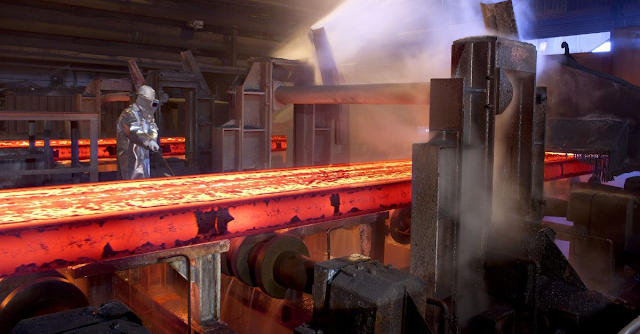
Hot rolling has the following characteristic, low intensity, good extension, the surface is not shinning.

Cold rolling has the following characteristic, high intensity, high hardness, shining surface.

Hot rolling mill: though high heating, then rolling it to the certain structure.

Cold rolling mill: not heating, in common temperature, normally below critical point.

The mechanical property through hot rolling and cold rolling is different.

Cold rolling is in low hardness, easy to process, with good intention, easy to form cold stress, hot rolling is for high hardness, high intention, difficult to process, not easy to deformation. 

Hot rolling needs to be heated, normally temperature should above the critical point, the processing is under high temperature, make the steel recrystallization happen, but not changing the steel structure.

Cold rolling is under normal temperature, roll it into aiming thickness, compare with hot rolling , cold rolling has high accuracy, smooth surface, better mechanic characteristic, especially processability, because the raw material of cold rolling is very crisp and hard, not suitable for processing, normally, cold rolling steel plate should be acid pickling and surfacing, then can send them to final customer.

The difference between cold rolling and hot rolling is not in the process, but the temperature, hot rolling is easy to roll, and high efficiency, but hot rolling makes steel oxidation, surface gray and not shining; cold rolling requires high power motor, low efficiency, high cost, but with very shining surface, can be used as the final product directly, widely used.


Monday, May 9, 2022

Why High-Speed Wire Rod Mill Adopts Collective Transmission Mode?

wire rod mill

Why High-Speed Wire Rod Mill Adopts Collective Transmission Mode?


In high-speed wire rod mill, the finishing mill adopts collective transmission mode, which is due to:

1) In order to shorten the excess length of the head and tail of the rolling piece caused by drawing, the structure of the rolling mill is required to be as compact as possible, so that the space between the stands is very small. Under this compact condition, it is impossible to arrange the rolling mill as a single transmission. 

2) The finishing mill of high-speed wire rod mill not only has high speed but also needs to be adjusted to different speeds according to different product specifications. If it is driven separately, the number of frames is large, and the speed required by different product specifications varies greatly in different sorties. Therefore, the required electrical control system will be very complex, and at the same time, it must have high sensitivity to adapt. 

Therefore, even if the electrical system can do it, it is difficult to maintain the micro-tension rolling relationship between the racks for all product specifications. 

3) The combined structure of collective transmission greatly improves the dynamic speed drop of the motor at the moment of biting and makes the micro-tension relationship between the stands unaffected by the electrical equipment, thus creating favorable conditions for the micro-tension rolling at high speed. 

In summary, the design of roughing mill, medium rolling mill and pre-finishing mills using AC motor drive alone, finishing mills using AC motor collective drive.


Thursday, April 14, 2022

Wire and Bar Rolling Mill & Reducing and Sizing Mill


Wire and Bar Rolling Mill

Wire and Bar Rolling Mill & Reducing and Sizing Mill


For a long time, the output of bar and wire rod in China has been between 40% and 50% of the total output of iron and steel products. In recent years, the total output of bar and wire rod has exceeded 400 million tons. Except for about 10% of exports, the rest of the output is used for domestic digestion. It can be seen that bar and wire rod products play a very important role in national economic construction. There are more than 1000 production lines in China. 

Since the 1980s and 1990s, China has introduced foreign advanced bar and wire rolling mill one after another. By digesting, transforming and upgrading this technical line, China's domestic bar and wire rolling mill equipment have approached the world's advanced level. With 12% of the imported international advanced level production lines, at present, it is above the domestic advanced level. Some of them accounted for about 75% and became the mainstream of the market. Another 20% of the ordinary rolling mills adopt the twist rolling process with large output, which is only suitable for the production of ordinary carbon steel. There are still 5% backward mills to be eliminated.

After more than 30 years of development, the types of bar mills can be classified into three categories: closed two-high mill, short stress path mill and cantilever roll ring mill. Among them, the closed two-high mill is mainly Morgan type and Simac type (including Demark type). Through introduction and digestion, Morgan type closed mill has been successfully applied to hundreds of domestic production lines. The main imported models of short stress path rolling mill are Danieli type and Premini type. Our major research institutes have developed their own brand of short stress path rolling mill, which has been applied in hundreds of bar and wire production lines in China. Cantilever roll ring mill is only developed by Danieli, but it is seldom imported in China, such as Laigang and Tangshan Iron and Steel Company, which is only used in roughing mill.

Bar reducing and sizing mill is a kind of mill installed in bar finishing mill to improve product size accuracy and product performance (rolling by controlling temperature). It is mainly used for a bar of special steel. Reduced sizing mill is different from common mill in three aspects: first, using clutch with speed ratio to meet the needs of different rolling speeds of all products; second, using minimum mill center distance to reduce the size impact of micro-tension rolling; third, using single pass carbide roll ring, roll as double support. Support to ensure sufficient stiffness to meet a wide range of product specifications. At present, there are two types of imported machines in China: two-high mill and three-high Y mill. The two-roll mill is mainly of the predominant type and the Danieli type. There are three-stand flat-vertical arrangement and a four-stand flat-vertical arrangement. The roll system of the mill adopts the frame structure of the short stress line mill with high stiffness. Three-roll Y mill is mainly KOCKS type and Simac type. It usually consists of 3-5 stands. Roll passes are arranged alternately by Y-Δ. 


wire rolling mill


steel rerolling mill

Wednesday, April 13, 2022

Hot Strip Rolling Mill Plant | Hot Strip Mill in Steel Plant | Strip Rol...


There are four types of hot strip rolling mill according to product width and production process: hot strip rolling with a wide strip, reversible hot strip rolling with a wide strip, hot strip rolling with a narrow strip, and hot strip rolling with a planetary rolling mill. The materials used for strip steel are plain carbon steel, low alloy steel, stainless steel, and silicon steel. It is mainly used for raw materials of cold-rolled strips, welded pipes, cold-bent, and welded sections, or for making various components.


Tuesday, March 29, 2022

What is a Wire Rod Mill Laying Head?

Wire Rod Mill Laying Head


What is a Wire Rod Mill Laying Head?


The laying head of wire rod mill is the key equipment in high-speed wire production to spin rolled wires into coils for collection.

Wire rod mill laying head is one of the key equipment in high-speed wire production and an important bottleneck restricting further speed-up of high-speed rolling mill. The quality of wire spinning directly affects the physical quality of high-speed wire. With its special shape structure and certain speed, the laying head changes the straight current wire moving at high speed into coils with stable ring shape and uniform spacing. With the increase of wire rolling speed and output, the requirement for wire rod mill laying head is getting higher and higher. Therefore, many high-speed wire production enterprises will have unstable coils in production, which will affect product quality and smooth production.

With the development of wire production technology, horizontal wire rod mill laying head has become the throat part of the production line as a coiling equipment matching with the uncoiled cooling line. Its function is to guide the wire rolled from the finishing mill K1 or pinched in a straight line into a horizontal laying head machine. The wire slips relatively without twist in the tapping tube with rotation. Under the action of centrifugal force, Coriolis force, inertia force and friction force, it bends and deforms gradually along with the shape of the tapping tube, reaches the required curvature at the outlet, forms the spiral coil and realizes its working purpose.

The high-speed wire rod mill laying head is a horizontal structure, which is located between the water-cooled box and the cold-controlled roll track of the controlled cooling line after the finishing mill. Horizontal laying head machine is composed of transmission device, shield, tapping disc, hollow shaft, tapping tube, bearing seat, motor, bevel gear pulley and other components. The threading machine is driven by a motor and driven by a pair of bevel gears meshing in the gear box to rotate the hollow shaft. The threading tube is installed on the threading disc, which is connected with the hollow shaft by bolts. 


wire rod mill laying head


Wire Rod Mill


Friday, March 18, 2022

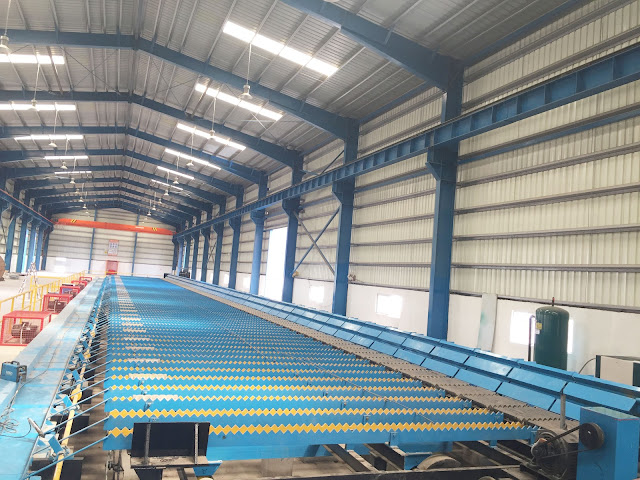
Walking Beam Cooling Bed

Walking Beam Cooling Bed

Walking Beam Cooling Bed

The walking beam cooling bed and continuous casting billet turnover cold bed series products are mainly applicable to bar, profile and billet production lines in iron and steel smelting industry. The step-by-step cold bed can meet the annual production capacity of 100-1 million tons.

The walking beam cooling bed consists of four parts, i.e. feeding system, body of the cold bed, leveling device and feeding device. The feeding system uses cylindrical roller bed to be tilted and positioned. Frequency converter roller bed motor drives independently. The feeding on roller bed is braked by a single skirt. The feeding mechanism includes curved plate type, pinch roll belt trough type and brake apron type. Brake apron lifting includes hydraulic, mechanical and other structural forms. The cold bed is step-by-step. Input roller is controlled by frequency conversion or driven directly by AC, while output roller is driven by AC.

Walking beam cooling bed is the working table for effective cooling of rolled products (threaded steel, round steel, steel pipe, etc.) in metallurgical rolling steel industry.

Classification:

 The walking beam cooling bed mainly include pull-tooth type, rack step type, pawl type, chain type and roller type.

Composition: 

The walking beam cooling bed consists of mechanical transmission system, water cooling system, working table of the cold bed, fixing support, etc.

Working principle: 

The rolled products are conveyed into the cold bed through the roller track, and then the work pieces arranged on the cold bed are moved to the top of the cold bed step by step by step by rack pulling the teeth. The cooling effect of the work pieces is achieved.

Main application: 

The walking beam cooling bed equipment is mainly used for slow natural cooling of rolled steel plate on-line. On the profile production line, the cold bed also has the function of pre-bending the profile to prevent irregular bending of the profile due to unequal quality everywhere during the natural cooling process.

Application field: 

Walking beam cooling bed is mainly used in iron and steel industry, metallurgical industry, etc.

Environment and Conditions for Equipment Use: 

Ambient Temperature: -20-+40 C

Working environment: not suitable for flammable and explosive

Altitude: +108 M


walking beam cooling bed


Tuesday, March 15, 2022

What is a Rolling Mill?

rolling mill

What is a Rolling Mill?

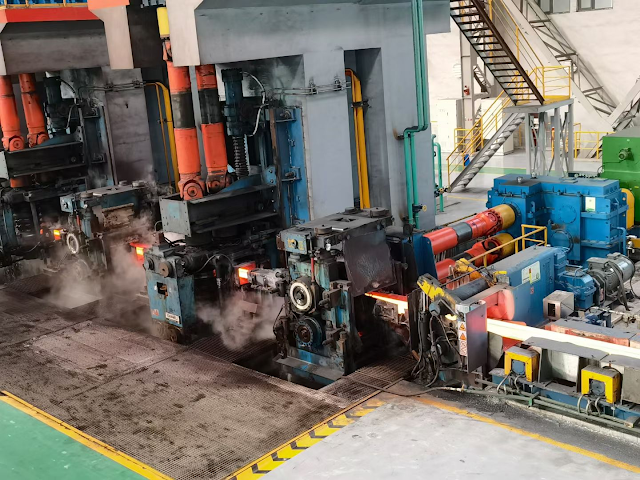
The steel rolling mill is the equipment to realize the metal rolling process. Generally refers to the equipment used to complete the whole process of rolling production, including main equipment, auxiliary equipment, lifting and transportation equipment and ancillary equipment. But generally speaking, the rolling mill only refers to the main equipment.

II. Nomenclature of Rolling Mill

It is named after the type of rolled product, the type of mill and the nominal size. The principle of "nominal dimension" refers to the section mill as the pitch diameter of the herringbone gear of the gear base; the blooming mill as the nominal diameter of the roll; the strip mill as the length of the working roll body; and the steel tube mill as the maximum diameter for production. It is sometimes named after the inventor of a rolling mill (e.g. Sendzimir mill).

III. Selection of Rolling Mills

The type and dimension of finished or semi-finished rolling mill shall be selected according to the requirements of product variety, specification, quality and output, equipped with necessary auxiliary, lifting, transportation and accessory equipment, and finally balanced according to the requirements of various factors.

IV. COMPONENTS OF STEEL ROLLING MILLS

1. Work stand: composed of roll, roll bearing, frame, rail seat, roll adjustment device, upper roll balance device and roll changing device, etc.

2. Roll: It is a part that makes metal plastic deform.

3. Roll bearing: support the roll and maintain the fixed position of the roll in the frame. Roll bearings vary greatly with heavy working loads, so small coefficient of friction, sufficient strength and stiffness are required, and rolls can be easily replaced. Different types of roll bearings are used for different mills. Rolling bearings are mainly used for work rolls of strip mills because of their high rigidity and small coefficient of friction, but their small pressure-bearing capacity and large size. Sliding bearings have two types: semi-dry friction and liquid friction. Semi-dry friction roller bearings are mainly bakelite, copper and nylon bearings, which are relatively inexpensive and are mostly used in profile mills and billet openers. There are three kinds of hydrodynamic, hydrostatic and hydrostatic bearings. The advantages are small friction coefficient, large pressure-bearing capacity, high working speed and good rigidity, while the disadvantage is that the oil film thickness changes with speed. Liquid friction bearings are mostly used for support rolls in strip mills and other high-speed mills.

4. Mill stand: It is composed of two "archways" to install the roll bearing block and roll adjusting device. It needs sufficient strength and steel strength to withstand the rolling force. There are two main types of rack, closed type and open type. Closed stand is an integral frame with high strength and rigidity, mainly used for blooming mills and strip mills with high rolling force. Open frame is composed of frame body and upper cover, which is easy to change rolls. It is mainly used in cross section mills. In addition, there are no archway mills.

5. The rolling mill track base is used to install the frame and fix it on the foundation, also called the floor plate. To withstand the gravity and tipping moment of the worker base while ensuring the accuracy of the mounting dimensions of the worker base.

6. Roll adjustment device: used to adjust the roll gap so that the rolled piece can reach the required section size. Upper roll adjustment device, also known as "press-down device", has three kinds: manual, electric and hydraulic. Manual press-down devices are commonly used in profile mills and small mills. Electric press-down device includes electric motor, reducer, brake, press-down screw, press-down nut, press-down position indicator, spherical pad and pressure gauge and other components; it has low transmission efficiency, large rotating inertia of moving parts, slow reaction speed and low adjustment accuracy. Since 1970s, AGC (Automatic Thickness Control) system has been used in strip rolling mills. Hydraulic press device has been used in new strip cold, hot and thick rolling mills, which has the advantages of small thickness deviation and high product qualification.

7. Upper roll balancing device: device used for lifting upper roll and preventing impact of rolled parts when entering and leaving the roll. Forms are: spring type, multi-purpose on profile rolling mill; hammer type, commonly used on blooming mill with large roll movement; hydraulic type, multi-purpose on four-roll strip rolling mill.

In order to improve the operation rate, it is required that the roll change of the rolling mill be quick and convenient. Roll change modes are C-hook type, sleeve type, trolley type and frame type. Roll change in the first two ways is assisted by crane, while the whole frame requires two sets of frame for roll change. This method is mostly used for small mills. Car roll change is suitable for large rolling mills and facilitates automation. At present, the rapid automatic roll changing device is used on the rolling mill. It only takes 5-8 minutes to change the roll once.

8. Driving device: It consists of electric motor, reducer, gear seat and connecting shaft. The gear base distributes the drive torque to two or more rolls.

9. Auxiliary equipment includes a series of equipment for auxiliary process in rolling process. Such as raw material preparation, heating, steel turning, shearing, straightening, cooling, flaw detection, heat treatment, pickling and other equipment.


rolling mill for sale


Featured Post

Bar & Wire Rod Rolling Mill Production Line Process Flow (Complete Version)

Bar & Wire Rod Rolling Mill Production Line Process Flow (Complete Version) 1. Bar Rolling Mill Production Line Process Flow  Billet acc...

Popular Articles

My Blog List

Wikipedia

Search results